

Xenogreen Across the Atlantic!
As part of the Xenogreen project, led by the BiodivAG research team, scientists are investigating the impacts of an amphibian species, the African clawed frog (Xenopus laevis) on ecosystems in the Maine-et-Loire region (Western France). Introduced to the area in the 1970s, this invasive alien species is also known as a historical host of the pathogenic fungus Batrachochytrium dendrobatidis (Bd). Suspected of having been spread worldwide through the trade of X. laevis for biomedical research, this fungus is now found in more than half of all known amphibian species and has been linked to widespread population declines and nearly 90 presumed extinctions.
This year, the team investigated the potential role of the African clawed frog in the transmission dynamics of this pathogen in Europe. A field survey conducted around Angers assessed the presence of Bd in three native amphibian species from Maine-et-Loire that share habitats with X. laevis. Molecular analyses based on DNA amplification were carried out on the ANAN platform (SFR Quasav).
This pilot study revealed a high prevalence of the pathogen in most of the sampled ponds and in more than 80% of African clawed frogs. The pathogen was also detected in nearly one-third of native amphibians, regardless of the presence of Xenopus laevis, and without any apparent clinical signs of infectious disease outbreaks. Preliminary results, presented as a scientific poster, are presented from June 8–12 at the Global Amphibian and Reptile Disease Conference in Knoxville, Tennessee (USA).
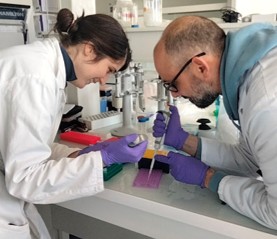
Picture of Eléonore Moreau (BiodivAG) and Julien Jeauffre (ANAN)
Detection of Batrachochytrium dendrobatidis in three native amphibian species within an invasive Xenopus laevis hotspot in Western France.
Gharnit, E 1*; Lesbarrères, D1,2; Kosciolek, C1; Moreau, E1; Jeauffre, J3; Pagano, A1
1 Univ Angers, BIODIVAG, F-49000 Angers, France
2 Université de Sudbury, Sudbury, Canada
3 Univ Angers, Institut Agro, INRAE, IRHS, SFR QUASAV, Angers, France
*corresponding author : elouana.gharnit@univ-angers.fr
